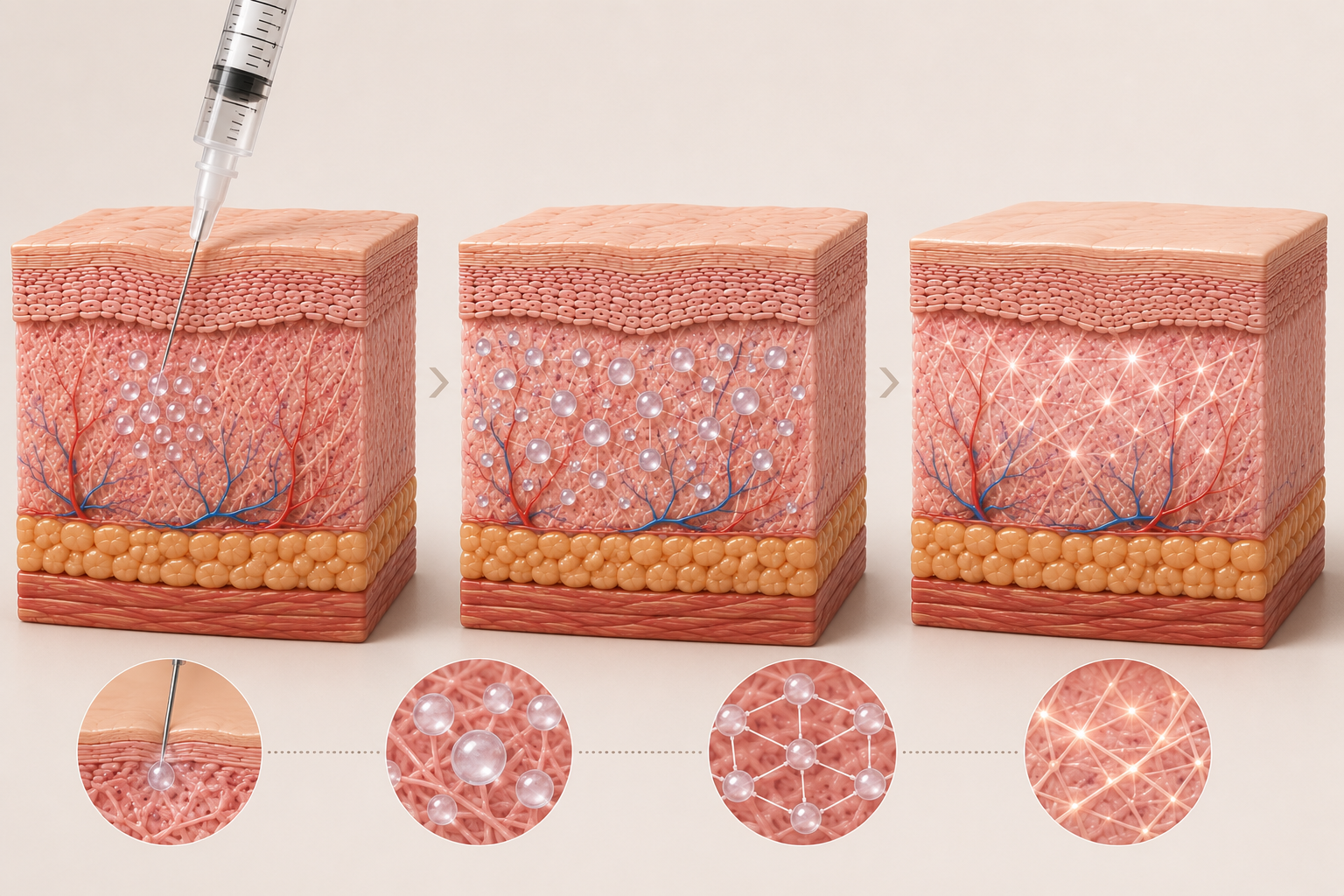
Healthy skin is influenced by more than the products applied to its surface. Hydration, collagen, elastin, skin barrier function and the gradual changes associated with ageing all contribute to how skin looks, feels and behaves.
Over time, some individuals may notice that their skin appears less supple, fine lines become more visible, or the complexion no longer feels as smooth and resilient as before.
For people exploring injectable skin rejuvenation treatments in Singapore, two commonly discussed options are Profhilo and skin boosters.
Both are associated with improving skin quality, and many formulations use hyaluronic acid, a naturally occurring substance that helps retain moisture within the skin.
However, Profhilo and skin boosters are not identical treatments.
The main difference is that Profhilo is a specific injectable hyaluronic acid formulation developed for skin bio-remodelling, while skin boosters are a broader category of injectable products intended to improve selected aspects of skin quality.
Their formulations, injection techniques, treatment protocols and intended effects can differ.
Understanding these distinctions is important when considering treatments for dehydrated skin, changes in elasticity, fine lines and other early signs of skin ageing.
Understanding Skin Hydration and Skin Ageing
Before comparing Profhilo and skin boosters, it helps to understand what happens beneath the skin's surface.
The skin is a complex organ consisting of multiple layers, each contributing to its structure, protection and appearance.
The outermost layer, known as the epidermis, provides a protective barrier against environmental influences while helping regulate moisture loss.
Beneath it lies the dermis, which contains collagen, elastin, hyaluronic acid and other components of the extracellular matrix.
Together, these structures help maintain the skin's strength, flexibility and hydration.
Why Does Skin Lose Moisture?
The skin naturally loses water through a process known as transepidermal water loss.
When the protective skin barrier is functioning properly, this moisture loss remains regulated.
However, several factors may influence the skin's ability to retain water, including:
Age-related changes in skin structure.
Frequent cleansing or excessive exfoliation.
Exposure to dry indoor environments.
Inappropriate or irritating skincare products.
Certain skin conditions affecting barrier function.
Environmental influences and ultraviolet exposure.
In Singapore, people frequently transition between humid outdoor environments and air-conditioned indoor spaces.
Air-conditioning can lower indoor humidity, potentially contributing to a sensation of dryness or tightness, particularly in individuals with an already compromised skin barrier.
It is important to distinguish between dry skin and dehydrated skin.
Dry skin is generally associated with insufficient skin lipids or sebum, whereas dehydration refers to reduced water content.
A person with oily skin can therefore also experience dehydration.
For a closer explanation, Rexults Clinic provides information on dry and dehydrated skin, including the factors that may influence skin comfort and appearance.
How Does Ageing Affect Skin Hydration?
Skin ageing involves gradual changes in the dermal extracellular matrix.
Collagen provides structural support, while elastin contributes to the skin's ability to stretch and return to its original shape.
Hyaluronic acid contributes to tissue hydration and the environment surrounding skin cells.
As the skin ages, changes in these components may contribute to:
Reduced skin elasticity.
Fine lines and wrinkles.
Changes in skin thickness.
Increased skin fragility.
Alterations in hydration and texture.
Reduced firmness and tissue support.
Ultraviolet radiation can accelerate some of these changes through a process known as photoageing.
Although injectable skin treatments may improve selected characteristics of ageing skin, they cannot reverse every biological or structural change.
This is why an assessment of skin quality is important before choosing a treatment.
What Is Profhilo?
Profhilo is an injectable treatment containing stabilised hyaluronic acid.
It is formulated using hybrid cooperative complexes of high-molecular-weight and low-molecular-weight hyaluronic acid.
Unlike conventional dermal fillers that are primarily used to restore volume or alter facial contours, Profhilo is developed to distribute within treated tissues and influence certain characteristics of skin quality.
The treatment is commonly described as an injectable bio-remodelling procedure.
How Does Profhilo Work?
Hyaluronic acid is a naturally occurring molecule with a strong capacity to attract and retain water.
Profhilo uses a specific formulation designed to distribute through the treated tissue after injection.
The intended effects include improvements in skin hydration and certain properties associated with elasticity and tissue quality.
Research has reported improvements in measures such as skin hydration, elasticity and mild laxity following treatment.
However, the quality and size of available clinical studies vary, and these findings do not guarantee a particular result for every patient.
What Makes Profhilo Different From Conventional Fillers?
One important distinction concerns the intended treatment objective.
Conventional volumising fillers are commonly placed into selected facial areas to restore volume or modify contours.
Profhilo is not primarily designed for targeted facial volume augmentation.
Its formulation and injection techniques are intended to distribute hyaluronic acid within the treatment area rather than create a specific facial contour.
Consequently, someone experiencing significant facial volume loss may require a different assessment from someone whose main concern is reduced skin hydration or elasticity.
What Skin Concerns May Profhilo Address?
Depending on the patient's condition and the product's indications, Profhilo may be discussed when concerns include:
Reduced skin elasticity.
Changes in skin texture.
Fine lines associated with skin ageing.
Mild skin laxity.
Changes in overall skin quality.
The face and neck are commonly discussed treatment areas, although suitability varies according to individual anatomy and clinical considerations.
Rexults Clinic provides additional information about Profhilo treatment in Singapore, including its intended applications and treatment considerations.
What Are Skin Boosters?
Skin boosters are a broad category of injectable treatments intended to improve hydration and selected aspects of skin quality.
Many skin boosters use hyaluronic acid as a principal ingredient.
However, the term does not refer to a single standardised product.
Different formulations may contain different concentrations of hyaluronic acid, use different manufacturing methods or incorporate additional ingredients.
Some products are designed primarily around hydration, while others are studied for effects on skin texture, elasticity or other characteristics.
This variation makes it important to identify the exact product being discussed.
How Do Skin Boosters Work?
Hyaluronic acid-based skin boosters are commonly introduced through multiple small injections into selected areas of the skin.
The water-binding properties of hyaluronic acid contribute to their intended hydrating effects.
Depending on the specific formulation, skin boosters may also influence certain measures of skin texture, elasticity or fine-line appearance.
However, the treatment mechanism, clinical evidence and expected duration differ between products.
It would therefore be inaccurate to assume that every skin booster produces the same outcome.
What Skin Concerns May Skin Boosters Address?
Skin boosters may be considered during medical assessment when concerns include:
Dehydrated-looking skin.
Fine lines.
Uneven skin texture.
Reduced skin suppleness.
Selected age-related changes in skin quality.
The appropriate product depends on the patient's skin condition, treatment goals, medical history and the available evidence.
Skin boosters are not substitutes for treating underlying inflammatory skin conditions, significant facial volume loss or substantial skin laxity.
Are Skin Boosters the Same as Dermal Fillers?
Not necessarily.
Although both may contain hyaluronic acid, their intended applications can differ considerably.
Conventional dermal fillers are often designed to provide structural support or restore volume in selected areas.
Skin boosters generally focus on improving skin quality rather than creating significant changes in facial shape.
Nevertheless, the distinction is partly formulation-dependent. Some injectable products have overlapping characteristics, and their use should be assessed individually.
Profhilo vs Skin Boosters: What Are the Main Differences?
Although Profhilo and skin boosters may share hyaluronic acid as an ingredient, they differ in several important ways.
These include product formulation, injection technique, intended treatment effects and clinical evidence.
The following comparison summarises the principal distinctions.
Which Treatment Is More Suitable for Your Skin Concern?
Choosing between Profhilo and skin boosters is not simply a matter of deciding which treatment provides more hydration.
Different skin concerns may have different underlying causes.
A person experiencing temporary dehydration may require a different approach from someone experiencing reduced skin elasticity or structural changes associated with ageing.
The following considerations help explain why.
1. Dehydrated Skin and Reduced Suppleness
Dehydrated skin may appear dull or show more noticeable fine lines.
However, dehydration can also result from impaired skin barrier function, environmental conditions or unsuitable skincare.
In such circumstances, appropriate topical care may be sufficient.
If injectable treatment is being considered, the doctor should determine whether the selected product is appropriate for the patient's skin condition.
Both Profhilo and certain hyaluronic acid-based skin boosters may influence measures of skin hydration.
The treatment decision depends on more than the presence of dryness alone.
2. Fine Lines and Early Skin Ageing
Fine lines may develop because of several overlapping factors.
These include changes in hydration, collagen structure, elasticity and repetitive facial movements.
Some fine lines are more noticeable when the skin is dehydrated.
Others reflect deeper changes in dermal structure.
Consequently, injectable skin-quality treatments may have different effects depending on the type and cause of the lines.
For readers interested in the underlying changes, Rexults Clinic discusses lines and wrinkles as part of its skin-ageing concerns.
3. Reduced Skin Elasticity and Mild Laxity
Skin elasticity is the ability of skin to return to its original shape after stretching.
With age, changes in collagen, elastin and other supporting structures can contribute to reduced firmness.
Profhilo has been studied for improvements in certain measures of skin elasticity and mild laxity.
However, it should not be viewed as a substitute for procedures specifically intended to address more pronounced tissue laxity.
Skin boosters may also influence elasticity, depending on the formulation and available evidence.
Individuals concerned about sagging or reduced firmness may benefit from understanding the broader causes of skin laxity before considering a particular injectable treatment.
4. Facial Volume Loss
Facial volume loss is a different concern from skin dehydration.
Over time, changes in facial fat compartments, bone structure and supporting tissues can affect facial contours.
These changes may contribute to hollowing, altered cheek shape or deeper facial folds.
Profhilo and skin boosters are not generally intended to provide the same targeted volume restoration as conventional dermal fillers.
Patients experiencing significant facial volume changes may therefore need an assessment of their facial anatomy rather than focusing exclusively on hydration.
Rexults Clinic also provides information on dermal fillers, which have different intended applications from injectable skin-quality treatments.
What Does Clinical Research Say About Profhilo and Skin Boosters?
Clinical research has examined the effects of hyaluronic acid-based injectable treatments on skin hydration, elasticity, texture and other characteristics of ageing skin.
However, the available evidence varies considerably between products.
Evidence for Profhilo
A systematic review published in 2026 examined nine studies involving 278 participants who received Profhilo or Profhilo Body.
The review reported improvements or trends toward improvements in several skin-quality measures, including hydration, elasticity, skin density and selected measures of laxity.
These findings are relevant, but they should be interpreted cautiously.
The overall evidence base remains relatively small, the studies differ in their methods and treatment areas, and some authors had manufacturer affiliations.
Further independent, adequately controlled research would help clarify the magnitude and duration of treatment effects.
Evidence for Skin Boosters
Research on injectable skin boosters includes studies of hyaluronic acid-based products and other injectable formulations.
A 2024 review highlighted the range of materials used in skin-booster treatments and their potential applications in skin rejuvenation.
A 2026 review likewise noted encouraging findings for aspects of hydration, elasticity and skin texture, while emphasising inconsistencies in terminology, clinical protocols and evidence quality.
Because skin boosters are a broad category, results from one formulation cannot automatically be applied to another.
The important distinction is that evidence for a particular product should guide expectations, rather than general claims about skin boosters as a whole.
Can Profhilo and Skin Boosters Be Combined?
Profhilo and skin boosters are not necessarily mutually exclusive.
However, there is no general requirement to receive both treatments.
Whether combining injectable treatments is appropriate depends on several considerations.
These include:
The specific products involved.
Their formulations and intended indications.
The anatomical areas being treated.
Previous injectable treatments.
Recommended treatment intervals.
Individual medical history.
Potential risks associated with additional injections.
Receiving more treatments does not automatically produce better outcomes.
In some circumstances, one suitable treatment may be sufficient.
In others, a clinician may determine that a different approach would be more appropriate.
Any proposed combination should have a clear clinical rationale and should not be based solely on the assumption that multiple treatments provide greater rejuvenation.
What Happens During Profhilo or Skin Booster Treatment?
Although injection techniques differ between products, both categories generally involve a consultation, preparation of the treatment area and administration by an appropriately qualified healthcare professional.
Before Treatment
The doctor should assess the patient's skin condition, medical history and treatment goals.
Relevant considerations may include:
Previous injectable procedures.
Known allergies.
Current medications.
Active skin infections or inflammation.
Relevant medical conditions.
Pregnancy or breastfeeding.
Previous complications following aesthetic procedures.
The doctor should also identify the exact product being used and explain its intended application.
During Treatment
The skin is typically cleansed before injection.
Depending on the treatment, a topical anaesthetic may be used to improve comfort.
Profhilo is generally administered using a defined injection technique.
Skin boosters may involve multiple smaller injections distributed across selected areas.
The precise technique depends on the product, treatment area and clinical assessment.
Discomfort varies between individuals.
After Treatment
Temporary reactions may include:
Redness.
Swelling.
Tenderness.
Bruising.
Small raised areas at injection sites.
Localised discomfort.
These effects may resolve over several days, although recovery varies.
Patients should follow the aftercare instructions provided by their treating clinician.
What Are the Risks of Injectable Skin Hydration Treatments?
Although hyaluronic acid occurs naturally within the body, its presence in injectable products does not eliminate procedural risks.
Common adverse effects are usually associated with the injection sites.
However, less common complications may include infection, persistent swelling, inflammatory reactions, nodules or vascular injury.
Accidental injection into or obstruction of a blood vessel can potentially result in tissue injury. In rare circumstances involving facial injections, serious complications affecting vision may occur.
Unusual severe pain, skin blanching or discolouration, or any change in vision following an injection requires urgent medical assessment.
The likelihood and nature of complications depend on the product, injection technique, anatomical location and other factors.
Patients should understand these risks before deciding whether treatment is appropriate.
How Long Do Profhilo and Skin Booster Results Last?
There is no single duration that applies to every patient or every injectable skin treatment.
The longevity of any improvement depends on:
Product formulation.
Treatment protocol.
Anatomical treatment area.
Individual skin characteristics.
Age-related changes.
Lifestyle and environmental influences.
Subsequent skincare and treatment decisions.
Profhilo and different skin booster formulations may have different recommended treatment and maintenance schedules.
It is important to distinguish between the time a product remains in the tissue and the duration of a measurable or visible treatment effect.
These are not necessarily identical.
Patients should therefore discuss realistic expectations, follow-up requirements and potential costs with their doctor.
Is Profhilo Better Than Skin Boosters for Skin Rejuvenation?
Neither treatment can be described as universally better.
Profhilo has a specific formulation and established treatment protocols designed around selected aspects of skin quality.
Skin boosters encompass a wider range of formulations, each with its own characteristics and intended clinical applications.
When comparing them, it is more useful to ask:
What is the underlying skin concern, and what evidence supports the proposed treatment for that concern?
Someone whose main concern is temporary dehydration may not require injectable treatment at all.
Someone with mild age-related changes in skin elasticity may have different considerations.
An individual experiencing significant facial volume loss or pronounced skin laxity may require assessment of other treatment categories.
Treatment selection should begin with identifying the concern rather than choosing a product name.
Why Skin Health Still Matters Beyond Injectable Treatments
Injectable skin-quality treatments do not replace the fundamental components of maintaining healthy skin.
Consistent skincare and appropriate sun protection remain important throughout adulthood.
For individuals living in Singapore, this includes managing ultraviolet exposure, recognising changes in skin barrier function and selecting products appropriate for their skin type.
A basic skincare routine may include gentle cleansing, suitable moisturisation and broad-spectrum sun protection.
Additional products or procedures should be selected according to individual skin needs.
Repeatedly undergoing aesthetic treatments without addressing underlying skin concerns may not provide a meaningful long-term approach to skin health.
At Rexults Clinic, the broader approach to medical aesthetics begins with understanding the patient's skin condition and determining what care, if any, is appropriate.
For individuals considering injectable skin hydration or rejuvenation, a medical consultation provides an opportunity to discuss the differences between treatments and understand their limitations.
To discuss Profhilo, skin boosters or other skin-quality concerns, contact Rexults Clinic through its official WhatsApp consultation channel.
Choosing an Appropriate Skin Rejuvenation Approach in Singapore
Skin rejuvenation is not a single procedure or a fixed treatment programme.
It involves understanding the biological changes occurring in the skin and determining whether an intervention is necessary or appropriate.
Profhilo and skin boosters represent different approaches within injectable skin-quality treatments.
Both may be considered for selected concerns, but their mechanisms, formulations and treatment protocols should be understood before making a decision.
For some individuals, a treatment focusing on hydration may be relevant.
For others, changes in elasticity, tissue support or facial volume may require a different assessment.
The most appropriate approach depends on the patient's individual characteristics, medical history and the expected benefits and risks of the available options.
If you would like to understand which options may be relevant to your skin, arrange a consultation with Rexults Clinic.